


Why the choice of mobile development technology is a business decision01
The choice between native and cross-platform mobile app development is often perceived as a purely technical issue. In practice, this is a strategic business decision that directly affects time to market, budget, user experience quality, and product scalability.
By 2026, mobile applications became part of complex digital ecosystems: they integrate with web services, analytics, CRM, payment systems, and internal business platforms. Therefore, a mistake in choosing the development approach can be costly even at the growth stage.
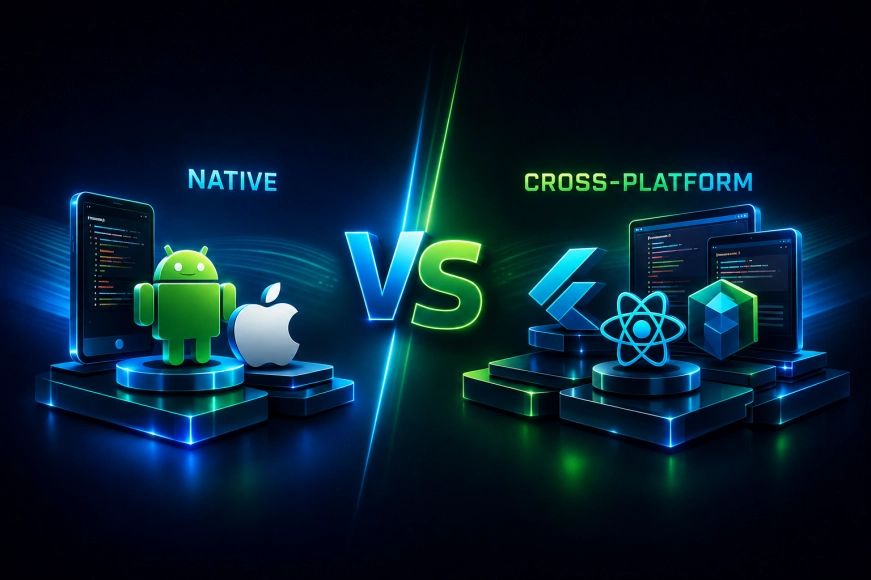
In this article, we will discuss:
- how native and cross-platform development fundamentally differ;
- in which cases each approach is justified;
- what risks are important to consider when choosing a technology.

What is native development02
Native development involves creating separate applications for each platform:
- iOS — Swift / Objective-C;
- Android — Kotlin / Java.
Each application is developed using the official SDKs and tools of the platform, ensuring maximum compatibility and control.
Key features of the native approach
- direct access to all OS capabilities;
- high performance;
- exact compliance with platform guidelines;
- stability during iOS and Android updates.
Native development provides maximum quality, but requires significant resources.
What is cross-platform development03
The cross-platform approach involves creating one code that works across multiple platforms. Frameworks are most often used to translate the common code into native components.
The main idea is to reduce development time and cost by reusing code.

Key differences between approaches04
The difference between native and cross-platform development is manifested not only in technologies but also in the consequences for the product.
Table 1. Native vs Cross-platform development
|
Criterion |
Native |
Cross-platform |
|
Performance |
Maximum |
Slightly lower |
|
UX and UI |
Full compliance with the platform |
Requires compromises |
|
Development speed |
Lower |
Higher |
|
Startup cost |
Higher |
Lower |
|
Access to OS API |
Full |
Limited |
|
Support and scaling |
Predictable |
Depends on the framework |
Performance and user experience05
In applications with high interface load and animations (marketplaces, fintech, streaming, real-time services) performance is critical. Native applications have an advantage here:
- less latency;
- smoother animations;
- stable operation under high load.
Cross-platform solutions are suitable for:
- MVP;
- service applications;
- products without complex graphics and animations.
UX and compliance with platform expectations06
iOS and Android users are accustomed to different interaction patterns. Native development allows:
- to fully follow Human Interface Guidelines and Material Design;
- to use native gestures;
- to adapt faster to new OS versions.
In cross-platform applications, UX often has to be unified, which can reduce the feeling of a "native" application.

Launch Speed and Time-to-Market07
One of the main arguments for cross-platform development is fast time to market.
It is justified if:
- it is important to quickly test a hypothesis;
- the budget is limited;
- product still not achieved product-market fit;
- frequent changes in logic are planned.
Native development takes more time but provides a stable foundation for long-term growth.
Product support and development08
When choosing an approach, it is important to consider not only the start but also the application lifecycle.
Native applications:
- easier to update for new OS versions;
- easier to scale by functionality;
- less dependent on third-party frameworks.
Cross-platform:
- dependent on the tool's ecosystem;
- may face delays in support for new APIs;
- require a careful architectural approach.
Our team in mobile projects always evaluates not only the current tasks but also development plans for the next 2–3 years.
Table 2. When to choose which approach
|
Scenario |
Recommended Approach |
|
MVP, hypothesis |
Cross-platform |
|
High Load |
Native |
|
Complex UX |
Native |
|
Limited budget |
Cross-platform |
|
Long-term product |
Native |
Typical mistakes when choosing technology09
- Choosing "because it's cheaper"
- Ignoring UX requirements
- Underestimating future load
- Lack of a development strategy
- Tying to a specific technology instead of business goals
How to make an informed decision10
A mature approach to technology selection includes:
- analysis of business goals;
- understanding user scenarios;
- load and scalability assessment;
- budget and timeline estimation;
- product development plan.
The technology must support the strategy, not dictate it.
Conclusions11
Native and cross-platform development — these are not competing but complementary approaches. Each of them is effective in its own context.
In 2026, the products that win are those that:
- choose technology consciously;
- consider UX, performance, and scalability;
- view the mobile application as a long-term asset.