


Custom web software — is not a luxury, but an infrastructural asset of the business01
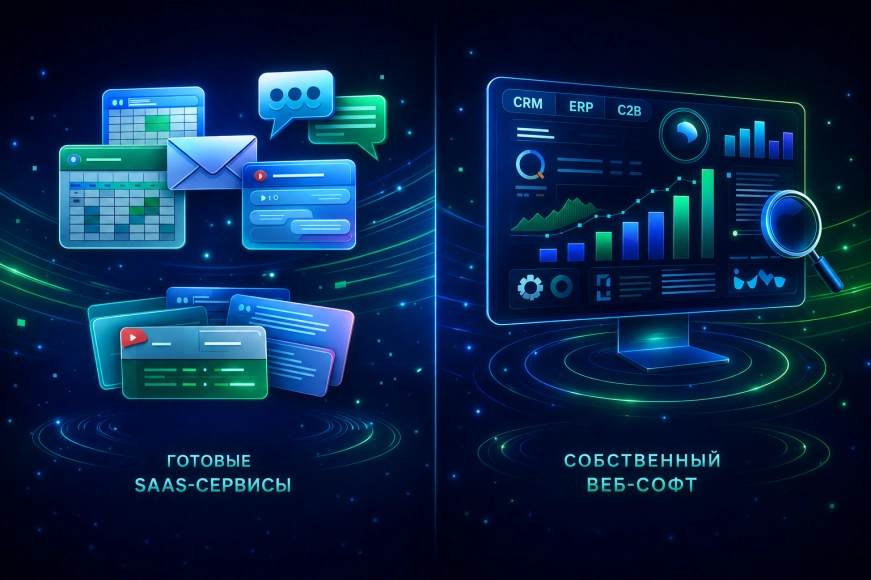
In 2026, custom web software ceased to be a privilege of large corporations. More and more companies are coming to understand that ready-made SaaS solutions and boxed products are no longer scaling with the business.

It is important to immediately establish the terminology: in this article, by custom web software we mean custom web solutions that operate through a browser:
- internal systems,
- CRM and ERP,
- B2B portals,
- personal accounts,
- digital platforms and services,
- internal automation tools.
This is not about PC software. This is about the digital infrastructure of the business that supports its processes, growth, and strategy.
Why ready-made SaaS solutions stop working02
At the start of a business, ready-made services seem like the optimal choice:
- quick launch,
- minimal investment,
- clear functionality.
But as the company grows, they begin to face systemic limitations:
- rigid logic that does not align with business processes;
- inability to flexibly change scenarios;
- increasing subscription costs;
- limitations on integrations;
- dependence on someone else's product strategy.
At some point, the business begins to adapt its processes to the service, rather than the other way around. This is the point at which the need for proprietary web software arises.
What proprietary web software gives to business03
Proprietary web software is not just an alternative to SaaS. It is a business management tool.
It allows:
- automate precisely those processes that create value;
- flexibly change logic without waiting for updates from third-party services;
- integrate data into a single ecosystem;
- make management decisions faster;
- reduce operational costs.
The key difference is — control. The business itself determines how the system develops and what tasks it solves.
Web software as an extension of the business model04
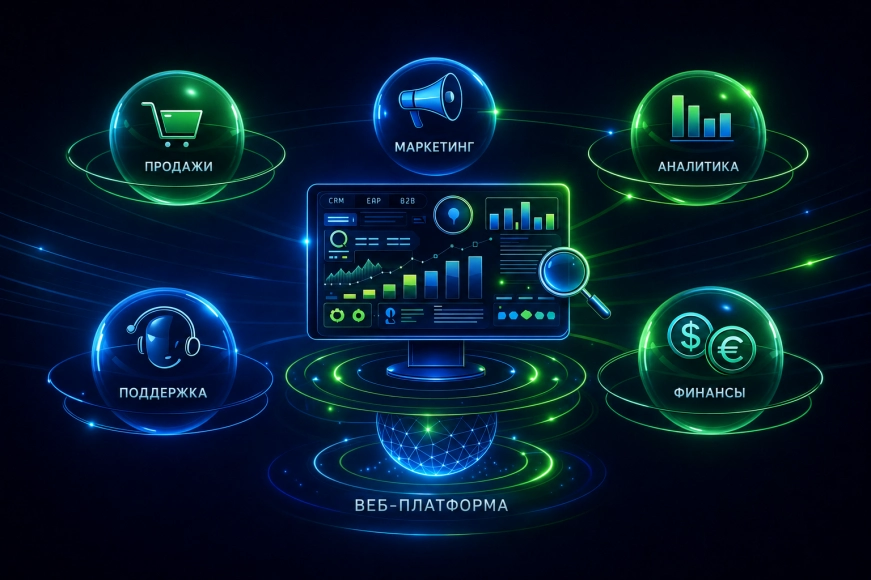
A common mistake is to view the development of web software as purely an IT project. In reality, proprietary web software is a digital reflection of the business model.
A good web solution:
- repeats the logic of the company's processes;
- supports the growth strategy;
- scales with the business;
- becomes part of the competitive advantage.
Our team in such projects always starts with analyzing processes and goals, not with choosing technologies.
When a business really needs its own web software05
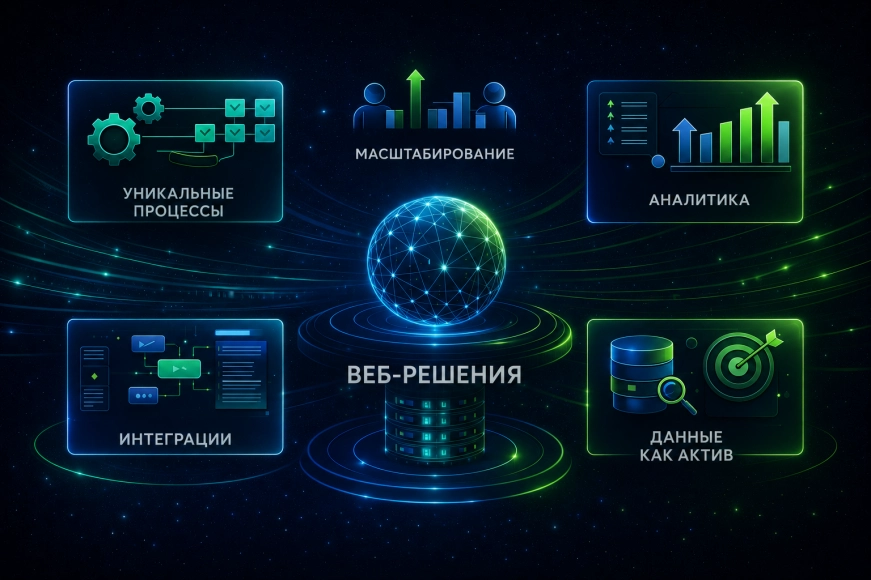
There are several typical scenarios in which a custom web solution becomes justified:
- Unique Processes
Ready-made services do not cover the specifics of the business. - Scaling
The number of users, operations, and data is growing. - Integrations
It is necessary to connect several systems into a single ecosystem. - Data as an Asset
It is important to own data and analytics, rather than renting them. - Competitive Advantage
Web software becomes part of the product or service value.
Table 1. Ready-made SaaS vs Custom Web Software
|
Criterion |
SaaS Solutions |
Custom Web Software |
|
Business Adaptation |
Limited |
Full |
|
Scalability |
Depends on the Service |
Managed |
|
Integrations |
Often complex |
Designed immediately |
|
Control over data |
Partial |
Full |
|
Long-term value |
Grows |
Optimizes |
The Economy of Custom Web Software06
Custom web software is often perceived as an expensive project. However, looking at a 2–3 year horizon, the picture changes.
Custom web software:
- reduces manual labor,
- decreases the number of errors,
- speeds up processes,
- reduces dependence on third-party services,
- allows for optimization of operational costs.
In the long term, this is an investment in efficiency, not just an expense.
Risks of web software development and how to mitigate them07
Custom development indeed carries risks:
- incorrect architecture,
- budget overruns,
- excessive functionality,
- accumulation of technical debt.
These risks can be mitigated by:
- phased development,
- modular architecture,
- clear prioritization,
- transparent requirements management.
The RUSO team in such projects always incorporates the possibility of system evolution, rather than a rigid monolith «forever».
Table 2. Risks and Ways to Minimize Them
|
Risk |
How to Reduce |
|
Complex system |
Modular architecture |
|
Budget growth |
Iterative Development |
|
Low Value |
Focus on Business Metrics |
|
Technical Debt |
Architectural Reviews |
Web Software as the Basis of Digital Transformation08
For many companies, proprietary web software is becoming a key element of digital transformation:
- processes become transparent,
- data becomes accessible,
- solutions — based on analytics.
In the conditions of 2026, such systems allow businesses to remain flexible and competitive.
Custom web software is not about technology for the sake of technology. It is about:
- control,
- flexibility,
- scalability,
- long-term business efficiency.
Custom web solutions are becoming the foundation of digital infrastructure and sustainable growth for companies.